


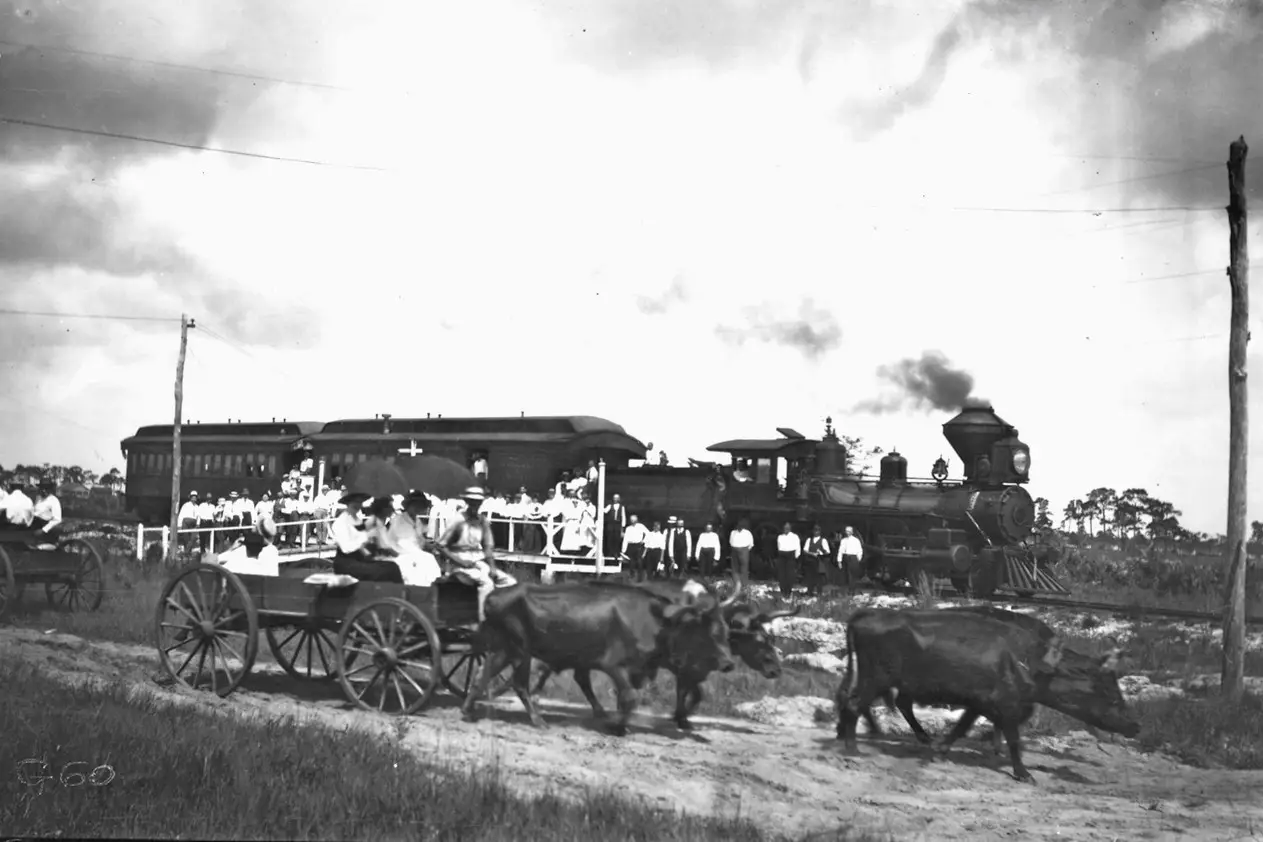


The History of the Fellsmere Railroad
Fourteen years prior to the Fellsmere Railroad being built, another railroad from Sebastian, Florida, was constructed to reach the site that Fellsmere now occupies. Like the Fellsmere Railroad, it emanated from the Florida East Coast Railway in Sebastian and ran west for approximately 9 miles. The name of the railroad was the Sebastian – Cincinnatus Farms Railroad, and it was built by Anthony O. Russell of Cincinnati, Ohio.1
On May 4, 1892, Anthony O. Russell, president of the United States Playing Card Company (manufacturer of the famous Bicycle playing cards) in Cincinnati, Ohio, bought 180 square miles of land in five townships in Brevard County from a partnership of Marks, Butt, and Palmer. Marks, Butt, and Palmer had purchased the property on December 27, 1890, from the “Trustees of the Internal Improvement Trust Fund” responsible for the sale of state-owned land.2 After purchasing the land, Anthony O. Russell created a company known as “Cincinnatus Farms” to begin a vast land reclamation project.3
On November 22, 1895, the Indian River Advocate published an article that Mr. Russell of Cincinnati said it would cost over $1 million and take two years to drain 112,000 acres to put it in shape for cultivation and be ready for settlers. He stated that a railroad from Kissimmee would be constructed to a point on the Indian River near Sebastian.4 On November 29, 1895, it was reported that the Cincinnatus Farms Land Development project, ten miles west of Sebastian, was steadily and surely developing. Work was to start on dredging the drainage canal in the next three months.5
In February 1896, Russell stated that work for reclaiming his tract of land, known as the Cincinnatus Farms, would begin as soon as the 10 miles of railroad from Sebastian was completed, the survey for which had been completed.6
Anthony O. Russell purchased approximately 3,000 additional acres for his railroad right-of-way from Sebastian to his Cincinnatus property. With the addition of the railroad right-of-way, Russell’s total property consisted of approximately 118,000 acres.7 J. O. Fries came to Sebastian in April 1896 to look after the right-of-way for the railroad.8
Following acquisition of the necessary right-of-way from Sebastian to Cincinnatus, construction of the Sebastian-Cincinnatus Farms Railroad began in April 1896. By May 1, 1896, William Lancaster, foreman for the right-of-way gang, reported that his gang had cut about one mile of right-of-way. H. B. Howard was given the contract for the ties to be used in the first mile of the railroad.9
May 15, 1896, was the first payday for the workers building the Sebastian-Cincinnatus Farms Railroad. Initially, 95 African American workers were brought in to cut trees down for railroad cross ties.10 Approximately 200 additional African American workers were employed to grade the railroad roadbed and cut 20,000 cross ties to lay the rails for the track. The Sebastian-Cincinnatus Farms Railway would bring in heavy machinery to accomplish the necessary drainage work Russell had planned. Once completed, he wanted to plant tobacco, rice, and sugar on the rich, fertile soil.11 Ten acres of the rich muck land along the railroad was to be planted in pineapples.12
By June 5, 1896, all the cross ties had been cut for the railroad west to the Sebastian River. The bridge builders were in the process of building the longest bridge along the Sebastian-Cincinnatus Farms Railroad which traversed over the Sebastian River. A new residence and office in Sebastian had been built specifically for Anthony O. Russell’s son, Willis, who was placed in charge of the project as superintendent by his father. Grading of the railroad bed was almost finished by June 5, 1896, and it was estimated that 25,000 cross ties would have been cut by June 12, 1896.13
The railroad right-of-way was a 100 feet wide.14 From Sebastian, the right-of-way ran southwest for 3½ miles, somewhat parallel to the south line of the “Fleming Grant”. The Fleming Grant was a 20,000-acre land grant (31.25 square miles) given to Captain George Fleming by the King of Spain on June 8, 1819.15 (The westbound lanes of County Road 512 from Louisiana Avenue to just before the St. Sebastian River) are located on the old railroad right-of-way that was sold to Indian River County).16 The railroad took a sharp curve to the west when it crossed the south prong of the St. Sebastian River. It then ran approximately 5.0 miles in a slight northwesterly direction to where the City of Fellsmere is today. Approximately 1½ miles from where the railroad crossed over the St. Sebastian River, it crossed about 350 feet south of the southernmost point of the Fleming Grant almost in direct alignment with the northerly projection of 100th Avenue in Vero Lakes Estates in Indian River County.17 All total, the Sebastian-Cincinnatus Farms Railroad was actually 8½ miles long, not ten as had been claimed at the time.18
On September 17, 1896, workers began to lay the rails. By September 25, 1896, over one mile of track had been laid.19 According to Victor Power of the Manufacturers Record, the railroad was built as standard gauge (4’-8½” between rails).19 According to Jesse Dixon, railroad engineer for the Fellsmere Railroad from 1912 to 1937, the railroad that A. O. Russell built was narrow gauge (most likely 3 feet wide between rails).21 Other sources also cited the railroad as being narrow gauge.22 Whether the Sebastian-Cincinnatus Railroad was standard gauge or narrow gauge, the Fellsmere Farms Company built the Fellsmere Railroad to standard gauge using 60 pounds per yard steel rail and rebuilt all of the trestles along the entire route.23
By October 23, 1896, seven miles of track work were completed so a train could make two trips per day hauling out rails from the Florida East Coast Railway connection in Sebastian to the end of the line.24 By November 20, 1896, W.W. Russell stated that ten miles of track had been completed.25
After all the rail was laid, excavation began on 34 miles of drainage canals to drain the mucklands.26 The depth of muck averaged from three to nine feet.27
Anthony O. Russell had planned to extend the railroad for a distance of 125 miles to Tampa;28 however, work stopped in 1900 when he died in April of that year.29 At the time, his son George Russell was living in Sebastian; Willis Russell had traveled by train to New York in December 1896 to attend to business connected with the development of Cincinnatus Farms.30
Unfortunately, the Cincinnatus Farms project became embroiled in litigation between Willis and George Russell concerning Anthony O. Russell’s estate. By 1909, there were eight different claims against the Russell estate. After the litigation was settled, Edward Nelson and Anne Palmer Fell bought all of the land for $155,000 ($1.31 per acre) on March 9 and 11, 1910.31
Nelson Fell incorporated the Fellsmere Farms Company on May 23, 1910.32 The Fellsmere Farms Company hired J. G. White and Company in New York City to do the surveying and engineering work.33 The first order of business was to design and build the Fellsmere Railroad within the old Sebastian-Cincinnatus Farms Railroad right-of-way. Fellsmere Farms Company General Manager Ernest H. Every, who had been affiliated for 20 years with railroad interests in Colorado, directed the construction of the standard gauge Fellsmere Railroad.34 Chief civil engineer T. F. Richardson of J. G. White and Company periodically traveled south from New York City to check the progress of the railroad.35
Fifteen trestles, totaling 451 feet, had to be rebuilt in their entirety including the longest one, a 130 foot long trestle over the south prong of the St. Sebastian River.36 A temporary saw mill was set up on site, and nearby pine logs were cut down and milled for the heavy timbers needed to build the trestles.37 The roadbed was built up from excavating the soil on both sides of the track which created drainage ditches for the length of the railroad. Most of the work was done manually by ten African American workers.38 They used natural white sand for ballast instead of the traditional stone ballast.39 Stone ballast was rarely used except for curves because it had to be imported from other states. In August 1910, the Fellsmere Farms Company bought its first locomotive from the Georgia Car and Locomotive Company and designated it as Engine No. 100.40 By September 1910, a mere three months from the time the Fellsmere Farms Company had been incorporated, the Fellsmere Farms Railroad was completed.41
By December 1910, a section car house, a section crew house, and a section boss or foremen’s house for two foremen had been built to respective provide shelter for the motor cars used on the railroad and for living quarters for the section gangs that worked on the tracks.42 The Fellsmere Farms Company signed a contract for $3,250 to purchase another locomotive and hired Irwin S. Lhoyd as the Chief Engineer to oversee operations on the Fellsmere Railroad.43
The Fellsmere Railroad was used to transport supplies, building materials, equipment, heavy machinery for excavating drainage canals, mail, and prospective land buyers to Fellsmere.44 For several years, the railroad was the only way to safely travel to Fellsmere. In June 1916 (almost five years after the Fellsmere Railroad was completed), the Sebastian – Fellsmere Road was completed which permitted the motoring public to safely travel to Fellsmere on a nine-foot-wide shell, marl, and Ojus rock road that had just been a narrow dirt trail.45
The Fellsmere Railroad interfaced with the Florida East Coast Railway (FECRwy) at the south end of the FECRwy’s commodity track. It was just south of the Sebastian depot which was located between FECRwy Mileposts No. 214 and 215.46
The Fellsmere Farms Company purchased three woodburning locomotives ranging from No.’s 100 to 102 between 1910 and 1923.47 The first locomotive, No. 100, hauled in machinery and materials to develop the town and its surroundings. Later, more powerful locomotives were purchased to haul in the heavy parts to assemble Lidgerwood Manufacturing Company excavators and colossal American Steel Dredge Company dredges that operated day and night to excavate the drainage canals.48 Buckeye ditching machines and well drilling machines to drill artesian wells were brought in by railroad as well as all the building supplies.49 Prospective landowners were put on flat cars ahead of the locomotive to travel to undeveloped farmlands west of Fellsmere. The prospective landowners were put ahead of the locomotives, so that the smoke and ash from the locomotives didn’t blow over them when they rode on the flat cars to view the undeveloped land.50
The railroad was the lifeline of Fellsmere for at least five years because Fellsmere was not accessible by water. Although the headwaters of the St. Johns River emanated west of Fellsmere, the water depth was too shallow for steamers to ply the river west of Fellsmere such as they could on the Indian River. Fellsmere was a landlocked community, not like the cities of Sebastian and Vero Beach which were located on the Indian River. It was only after the nine-foot-wide Sebastian-Fellsmere Road was improved by Coats and Company in early 1915 that automobiles and trucks started coming to Fellsmere on a frequent basis.51 The road was not entirely completed until 1916 which made travel by motor vehicles safe.52 Vehicular traffic steadily grew over the years which eventually caused the demise of the Fellsmere Railroad in 1952.53
In addition to the section gang and section foremen’s house, and the motor car sheds built in 1910, many more structures were built north of town to support the railroad. These structures included a water tower, blacksmith shop, machine shop, and oil house which were all in place by 1913.54 Other structures such as the car barn, freight house, and warehouse were built by 1916. Two small sidings were constructed at the north end of Fellsmere, one to serve the freight station and one to serve the warehouse. A temporary repair siding was laid from the main line to the rear of the machine shop north of North Cypress Street.55
On April 4, 1911, the Fellsmere Farms Company approved the purchase of a railroad passenger car in the amount of $2,300.56 The railroad was officially opened to the public on May 1, 1911.57 Initially, it ran two passenger trains daily (Monday through Saturday) leaving from Fellsmere at 9:30 a.m. and 4:30 p.m., respectively arriving in Sebastian at 10:15 a.m. and 5:15 p.m. It ran one train daily from Sebastian to Fellsmere leaving Sebastian at 11:45 a.m. and arriving in Fellsmere at 12:30 p.m. On Saturdays, it ran an additional train that left Sebastian at 6:15 p.m. and arrived in Fellsmere at 7:00 p.m. There were no passenger trains running on Sundays. One stop was made between Sebastian and Fellsmere at the Sebastian River Bridge, 4.56 miles west of Sebastian.58 By 1912, there were so many people coming to purchase land around Fellsmere that the Florida East Coast Railway made Sebastian a regular stop instead of a flag stop.59
By February 21, 1912, the Fellsmere Railroad had completed the railroad roadbed from the west side of Fellsmere to a point beyond Lateral “U” (the first major drainage canal, approximately two miles west of town), and was ready to lay the rails.60 By March 7, 1912, it was reported that the railroad had been extended to a point west of Lateral “S”, two miles west of Lateral “U”.61 The railroad, now 11½ miles long, was being actively operated as a common carrier, transporting U.S. mail, and carrying passengers, freight, and express matter.62 Fellsmere Railroad trains ran to meet Florida East Coast Railway southbound train No. 29 and northbound train No. 30 at Sebastian.63
On April 20, 1912, Engine No. 100 was traded in to the Georgia Car and Locomotive Company and together with cash, the Fellsmere Railroad purchased a new, more powerful, woodburning locomotive that became Engine No. 101.64 Also, a new motor car was purchased that was identical to the motor car the Fellsmere Railroad had initially bought.65
In September 1912, the Fellsmere Farms Company announced that due to the rapidly increasing demand for larger and better facilities for handling the passenger and freight business in Fellsmere, plans were being made for a “commodious depot” to be built on the south side of the railroad tracks at the northern terminus of Broadway.66
Work started on the station by E. M. Botts, a contractor from West Palm Beach, Florida, on January 6, 1913. The 12-foot by 32-foot building was of board and batten construction with a shingle roof. It had a 12-foot by 14-foot central office with four windows in the middle. There were two waiting rooms under roof with open sides. On one end was the waiting room for “whites” and on the other end was a waiting room for “coloreds” in accordance with the Jim Crow laws in Florida at the time. The building was painted in the standard Fellsmere Farms company colors – white with green trim and a red roof. A 75-foot-long platform was also constructed along the track. Opposite the station, a small fenced in park with shade trees was made.67 The station was completed in less than two weeks.68
A small bridge over the ditch along the south side of the Fellsmere Railroad main line led to a sidewalk on the east side of Broadway. The sidewalk led to the Fellsmere Inn at the northeast corner of Broadway and New York Avenue where many travelers and workers stayed after arriving in Fellsmere.69
Construction of the freight station to the east of the passenger station was started during the week of January 20, 1913. The freight station was built at the foot of North Pine Street on the north side of the mainline track.70
In January 1913, negotiations took place between the Fellsmere Farms Company and the Florida East Coast Railway to build a “Y” track on the south side of the Fellsmere Railroad mainline, approximately 1½ miles west of Sebastian. The “Y” track enabled Fellsmere Railroad locomotives to turn around by leaving the railroad cars on the main track, recouple to the railroad cars, and head back to Fellsmere with the front of the locomotive facing west towards Fellsmere.71
In February 1913, the Fellsmere Farms Company decided to purchase a second locomotive and a passenger coach to take care of the rapidly increasing business on the railroad. The new locomotive weighed 35 tons. The new coach car was 50 feet long and had a 60-passenger seating capacity. The interior finish was of oak and the seats were upholstered in imitation leather. The new coach was to be used for “white” passengers only. The front half of the existing combination coach (Jim Crow car) would be used for “coloreds” and the rear half used as a “smoker”.72 A baggage compartment separated the front and rear compartments.73
Also, in February 1913, an oil house just to the west of the machine shops was built to store all flammable materials away from the town. All of the oil supplies that were stored in the Fellsmere Railroad warehouse were transferred to the well ventilated oil house.74 An industrial sidetrack from the mainline was being built in February that would pass in front of the Fellsmere Electric Light and Ice Plant. The plant was located to the north and opposite the Fellsmere Railroad station. The “Industrial Track” ran from the east side to the west side of Fellsmere and was constructed approximately 200 feet north of and parallel to the main line. The Florida East Coast lumber sheds, two tomato packing houses, and a fertilizer warehouse were built along the Industrial Track.75
By February 20, 1913, the new platform at the station was extended another 25 feet to the east and west, making the total length 125 feet long. Large lamps were placed on the platforms and seats were installed in the waiting rooms on both side of the station. A station sign with the name “Fellsmere” was placed on the east end of the station.76
On March 3, 1913, the new locomotive, Engine No.102, arrived from Albany, Georgia, and was placed under charge of locomotive engineer, E. C. McIlvane.77 As soon as Engine No. 102 and the passenger coach car arrived, a second train was implemented between Fellsmere and Sebastian that eliminated the motor car service.78
Also, during the beginning of March, the Fellsmere Farms Company, in order to promote the development of the sugar industry at Fellsmere, offered to construct railroad track along the bank of the Lateral “S” canal to a mill site located on Fellsmere Farms Tract 1322. The offer devoted a block of land for the mill and multiple tracts of land west of Fellsmere to any person, firm, or company who could erect a sugar syrup mill capable of handling 1,000 acres of sugar cane. A total of 2,086.78 acres was placed in reserve by the Fellsmere Farms Company for growing sugar cane.79
On April 1, 1913, the Fellsmere Railroad ran three daily round trip trains between Fellsmere and Sebastian except on Sundays. Motor cars were also used daily to make the round trips except on Saturdays. One stop was still made at the Sebastian River Bridge.80
The Fellsmere Railroad discontinued motor car service between Fellsmere and Sebastian on Sundays beginning June 1, 1913. The railroad then operated a regular passenger train on Sunday afternoons leaving Fellsmere at 4:30 p.m., departing Sebastian at 6:15 p.m. for the return trip to Fellsmere.81 On June 9, 1913, the first train crossed the railroad bridge at Lateral “U” which had just been completed.82
On October 18, 1913, the Fellsmere Railroad put two new passenger coaches into service. One of the coaches was a combination baggage car with a smoking compartment and a section for “colored” passengers. The other was a regular modern coach, 54 feet 4 inches in length with a seating capacity of 56 people. Both coaches were equipped with Westinghouse air brakes, train signals, and emergency valves. They bore the inscriptions “Fellsmere Railroad Company”, and “United States Mail and Baggage” in gold in the regular Pullman colors. The old coach was sold back to the Georgia Car and Locomotive Works.83
In November 1913, various repairs to bridges and trestles, recommended by Chief Engineer Irwin S. Lhoyd, along the Fellsmere Railroad were completed.84 Also, the Fellsmere Railroad Company added another station in compliance with a request from a number of petitioners from the Eureka District near the Roseland Road and Wabasso-Sebastian Road intersection. The new station was named “Kitching”, and it was located 3.61 miles west of Sebastian and 0.3 miles east of the Sebastian River Bridge.85 The station was named after Sylvanus Kitching who maintained a general store near the intersection. There was a one room schoolhouse at Eureka located in the same general area of the new station.86 Both sites are no longer in existence.
By the end of November 1913, a sidetrack or loop was installed by the railroad at Sebastian for the convenient handling of the Fellsmere trains. The largely increased freight and passenger business necessitated the additional trackage.87
In December 1913, the turning “Y” track in Sebastian was completed. The “Y” track was built on the north side of the mainline track 1.37 miles west of Sebastian. The distance between the east and west switches for the “Y” track was 1,010 feet along the mainline track.88
On Saturday, March 14, 1914, the L. H. Eschman European Railway Circus rolled into Fellsmere for two performances, at 2 p.m. and at 8 p.m. This was Fellsmere’s first circus in town, and it was a first class one-ring show. Some of the featured performers were Professor York and twelve educated Arabian ponies; Little Nemo, the highly educated elephant; Buster, the dog with the human brain; The Flying Fowler Troop of high trapeze artists; Frazier Clark and Family on the Flying Up-Side-Down ladders; Fred, Gay, and Claude Fowler and Henry Johnson, celebrated clowns of pantomime; contortionists, wire walkers, illusionists, equilibrists, and teeth ascensionists. The circus tents were pitched near the fertilizer warehouse on the north side of town. According to the Fellsmere Tribune, there was no doubt that a large number of citizens would attend the performances.89
On May 14, 1914, the Fellsmere Railroad Company reported that it was changing its “Y” track from the north side of the mainline track to a point just south of the observation tower east of the city.90 The new “Y” track was located within Tracts 1463 and 1464 immediately to the west of the western city limits of Fellsmere and north of 97th Street, the westerly continuation of New York Avenue beyond Myrtle Street.91
On November 7, 1914, the Fellsmere Railroad Company reported that a spur line had been built out from Kitching station to the nearby sawmill owned by D. Gantz to facilitate the shipping of lumber sawn by him.92
The Kissimmee Valley Gazette reported in December 1915 that the Fellsmere Railroad Company proposed to build a 3½ mile extension from its western terminus to Broadmoor with its own forces.93 Broadmoor was a town five miles to the west of Fellsmere but smaller in size.94
On January 2, 1915, it was reported that Robert Carson was constructing a substantial 20-foot by 30-foot warehouse across the street from the Fellsmere Electric Light and Ice Plant just north of the switch north of town.95
In early 1915, Chief Engineer William Alden James had surveys run for the extension of the railroad to Broadmoor.96 By March 6, 1915, the road and railroad gangs were leveling the railroad grade whose fill had been raised above natural grade by the dredge Fellsmere in February.97 On April 12, 1915, ten cars of cross ties were delivered for the Fellsmere Extension to Broadmoor.98 By April 24, 1915, the ties had been placed and the steel rails were being laid. The rails were laid as far as Lateral “S”, about 1¼ miles east of Broadmoor.99 As of May 28, 1915, the railroad had reached Broadmoor.100
Plans were to extend the railroad west to a community known as Grassland (which was never built), and further to connect to the Kissimmee Valley Branch segment of the Florida East Coast Railway that ran between Kenansville in Osceola County and Yeehaw at the southwestern corner of Indian River County.101 However, torrential rains that flooded Broadmoor and Fellsmere on July 31-August 1st, 1915, put an end to the expansion of the Fellsmere Railroad to the west. The torrential rains caused the Fellsmere Farms Company to go bankrupt in 1916 and into receivership in 1917.102
In August 1915, a temporary railroad nicknamed the “Fellsmere Shortline” was built by A. F. Sanders, a local contractor who was building the Fellsmere Public School at 22 South Orange Street. Since Fellsmere had dirt roads, the first order of construction was to build a railroad to haul all of the heavy materials such as brick and cement to the school site. The “Fellsmere Shortline” ran from the Fellsmere Railroad north of South Carolina Avenue down the center of Cypress Street approximately ½ mile to the school site in order to deliver the building materials. By September 1915, Sanders’ crews had completed the “Fellsmere Short Line Railroad”. Sanders had a special railcar built in Palatka to haul materials to the school site on 4ʺ by 4ʺ heart-of-pine rails spiked to 2ʺ by 8ʺ crossties. The little railcar was shipped to Fellsmere on a Florida East Coast Railway flat car, and then offloaded from a flat car.103 When the school was completed in 1916, the track was entirely removed.
In October 1915, the Fellsmere Railroad reported that the new 16-foot by 116-foot train shed on Wyoming Avenue was nearing completion. The workmen were waiting arrival of the sheeting material. Frederick Trimble, the architect for the Fellsmere Public School, was in charge of the work.104 Trimble not only designed the Fellsmere Public School (his first public building commission in Florida) but also many of the Fellsmere Railroad buildings, and the original two-story post office building on Broadway.105
The train shed was using for scraping paint off the passenger cars and repainting them. At the end of October 1915, passenger coach No. 51 was thoroughly scraped, and cleaned, and was receiving a coat of dark olive green paint. As soon as the work was completed, the combination coach was scheduled for the same treatment.106
The Florida Health Train arrived in Fellsmere on June 1, 1916, and stayed until the following day. It had several health-related exhibits, one being a working model of an Imhoff sewage treatment plant.107
On April 6, 1917, Congress passed a resolution declaring war on Germany thrusting the United States into World War I.108 This declaration of war gave the United States Railroad Administration authority to take control of all railroads in the United States. Several sources stated that the rolling stock from the Fellsmere Railroad was sent north.109 Contrary to what has been written, the Fellsmere Railroad was not taken over by the federal government and its passenger cars were not sold off for troop movements in the northeast. This was verified by the Florida Railroad Commission reports.110
In February 1918, the Fellsmere Railroad converted a standard Ford Model “T” automobile to a motor car by outfitting it with flanged wheels to ride on the tracks. The converted car was strictly used for passenger service only. It proved successful, so that locomotives and coach cars were not needed to take passengers to and from Fellsmere to Sebastian.111 The little railroad motor car or automobile was nicknamed “The Dinky.”112
On April 20, 1918, it was announced by the Fellsmere Tribune that the Fellsmere Railroad had just completed a new body for its Ford Model “T” that was recently converted to a railroad car. The new motor car was larger and accommodated more passengers than the previous motor car. The new motor car was such an improvement that the Fellsmere Railroad was considering making similar motor cars in the future.113 J. M. Pennington drove the Dinky to and from Fellsmere and Sebastian for many years.114 A turntable was constructed at Sebastian, so the Dinky could be turned around by hand by the operator, so the Dinky faced the opposite direction for the return trip to Fellsmere.115
On June 2, 1924, the Trans Florida Central Railroad (dubbed the “Dinky Line”) took over operations.116 With financing from Patrick Vans Agnew (Marian Fell’s husband) and other financiers, all from Winter Park, Florida, the Trans Florida Central Railroad was formed for a total distance of 16.04 miles, ending 84,710 feet from its beginning in Sebastian.117 The Trans Florida Central Railroad bought the Fellsmere Railroad and re-constructed the line from Fellsmere to Broadmoor. The line hadn’t been used since the great flood of 1915.118 The track had to be cleared of vegetation and rotten ties had to be replaced.119 Due to the efforts of Fellsmere entrepreneur Frank Heiser, the Standard Ammoniates Company built a huge, $250,000 fertilizer plant during the early part of 1924 to process the muck (rich organic soil) in the area of Broadmoor.120 Construction of the plant was started by January 1924. It had over 200 dryers and had the capacity to dry 200,000 tons of muck per year.121 The Broadmoor fertilizer plant product consisted of organic ammonia, and ammonia enriched dried muck.122 Tons of dried muck were shipped to the FEC Railway in Sebastian and the enriched muck was shipped by rail to fertilizer processing plants all over the United States.123 Engine No. 101 was pressed into service to haul the freight cars loaded with dried muck to Sebastian.124 However, another larger woodburning locomotive was needed to haul the cars from the fertilizer plant. As a result, the Trans Florida Central Railroad purchased Engine No. 103 from Southern Iron and Equipment Company on April 4, 1924. It was the last engine purchased by the company.125 A mixed passenger and freight train started operating between Broadmoor and Sebastian a minimum of three days per week after Engine No. 103 began service.126
On May 8, 1924, the Vero Press reported that Trans Florida Central Railroad Assistant Engineer La Bruce and his survey party completed a survey for the extension of the railroad to the west coast of Florida and Tampa. The extension was never constructed, probably because of the cost and the deep muck deposits west of Broadmoor which would have required extensive piling and trestles making the project cost prohibitive. There were also no good prospects for generating revenue along the extension to justify the expense of extending the railroad further west.127
The Hurricane of 1926 destroyed the remaining old Fellsmere Railroad car shed and the freight depot. Fire destroyed the machine and repair shops, and ironically, the water tower.128
In 1927, there was no market for dried peat, so the muck plant closed down for good.129 However, citrus, pulpwood, vegetables, and molasses continued to be shipped from Fellsmere via the Trans Florida Central Railroad.130
In the 1930s, the railroad used three Model “A” one-ton Fords which had been converted into motor cars and steam locomotive No. 101 was scrapped. Two motor cars were used by the railroad company and one of the car was converted/outfitted with a body to carry 12 passengers and express shipments.131
In 1932, during the Great Depression, Frank Heiser established the Fellsmere Sugar Company and made plans to construct a sugar mill to process raw sugar.132 Tracks were laid from the main line on the Broadmoor extension, south to the sugar mill to ship out the sugar and bring in railroad cars and supplies, and to bring laborers from Fellsmere to work in the mill on a daily basis.133
In 1933, the Fellsmere Sugar Company used the chassis of an International Harvester truck with a Ford Model “A” engine and converted it into a motor car that was powerful enough to pull freight cars.134
From the early 1930s through the early 1960s, the Fellsmere Sugar Company operated a labor train on the Trans Florida Central Railroad tracks. Laborers from the African American community northeast of Fellsmere had to walk at least ½ mile or more or hitch a ride to get to the train which was parked on the tracks north of Fellsmere. John David Spivey drove the labor train for many years from Fellsmere to the sugar mill and back. He would leave around 7 a.m. to take the laborers out to the mill for the morning shift and bring them back around 3 p.m. Sometimes, he would go back out around 11 p.m. to bring the workers back to Fellsmere if they worked a double shift.135
The railroad cars were covered and contained benches which could accommodate to 10 laborers. There were usually 10 to 12 railroad cars that the most powerful Dinky hauled to and from Fellsmere to the sugar mill. After Spivey returned to Fellsmere from the mill, he would park the cars, uncouple the Dinky, and turn it around on a turntable between North Orange Street and Broadway, so it could be ready to pull the labor train in the opposite direction.136
The train took about an hour to get to the sugar mill. The train would travel approximately three (3) miles west from Fellsmere past the Lateral “U” drainage canal and then take a 90° turn south for 2½ miles along the “Railroad Canal” to the sugar mill.137 The railroad tracks along the railroad canal are still there to this day but for the most part, the tracks are covered by soil and vegetation. The dirt road alongside the canal was once known as “Railroad Road”.138
In 1931, Engine No. 103, was parked for good on an unused side track where it remained until it was scrapped during World War II.139 It was the finest locomotive ever to travel on the railroad.
In 1935, Heiser decided to construct a sugar refinery and produce sugar under the label “Florida Crystals”.140 The large Dinky (International Harvester) would haul the sugar in freight cars to Sebastian after which the Florida East Coast Railway took the cars and transported them. However, none of the motor cars were equipped with air brakes, so a brakeman was required to ride the cars to stop the train!141 There was even a double ended hybrid rail-motor car built called “The Beast” which was used to haul freight cars. The Beast had motors and controls at both ends, so it did not have to be turned around.142
D. B. Russell of Yeadon, Pennsylvania, rode in the Dinky on December 26, 1940, and wrote the following of his account: “On the day after Christmas, 1940, I rode the Trans Florida Central jalopy and met its operator, 19-year-old J.M. Pennington. Being the only passenger, I sat up front. The wind whipped past my ears. I clung tightly to my side of the seat, while Pennington screamed at me, above the clang-bang-clank of the wheels, about the track’s condition and what state highways had done to private railroads.”143
Joel Tyson, longtime resident, councilman, mayor, and historian of Fellsmere related his personal experience about riding in the Dinky in the mid-1940s as follows:
“Sometime during the mid-1940s, I came to Fellsmere from Kissimmee via bus to visit my brother, Marvin. At that time, Marvin was working as a ranch hand at the Circle F Ranch. He had advised me, when we were planning my visit, that he might be unable to meet me at the bus stop in Sebastian. He said if he was not there to meet me, I was to walk over to the Sebastian train station and ask for Mr. Pennington and he would give me a ride to Fellsmere on the “Dinky”.
As it turned out, no one was there to meet me, so I followed my brother’s instructions. I eventually found John M. Pennington, over at the Sebastian Florida East Coast Railway station, loading the mail and cargo into “The Dinky” an old cargo truck that had been converted from a regular over-the-road vehicle to one that ran on rails. The tires had been replaced with steel flanged railroad wheels, and it had a “V” shaped structure mounted on the front known as a “cow catcher”.
When he finished loading the items into the truck, Mr. Pennington said, “Get up in there boy, and I’ll take you to Fellsmere.” The “Dinky” probably didn’t run much faster than 10 miles per hour, so after what seemed like a very long time, we finally stopped. When Mr. Pennington opened the side door, we were in Fellsmere at the north end of Broadway where the Fellsmere Railroad depot was located.144
In 1944, the Trans Florida Central Railroad was sold to the Fellsmere Development Corporation. From 1946 to 1948, seven 8-ton Whitcomb diesel engines were brought in to use for hauling carloads of sugar to Sebastian. The engines had no air brakes, so like the Dinkys, brakemen had to ride the cars in order to stop the train.145
After the Sebastian-Fellsmere Road (which became State Road 512 and later County Road 512), was hard surfaced and widened automobiles and trucks eventually eliminated the need for the Trans Florida Central Railroad. By the end of World War II most of the railroad buildings were demolished.146
Following World War II, the railroad experienced years of substantial loss and on October 6, 1952, the Interstate Commerce Commission authorized the Trans Florida Central Railroad to shut down and abandon its line.147 On November 30, 1952, the railroad ceased operations after 42 years of service.148
The tracks and railroad crossings were removed by the Thompson Contracting Company of Ft. Pierce during 1956 and 1957.149 By then, all of the structures associated with the railroad had been demolished with the exception of the Section Foremen’s house which had been used as a duplex for two railroad section foremen. After the demise of the railroad, it was used as a private residence until November 2013. The 543 square foot Section Foremen’s house is the last and only remaining Fellsmere Railroad building in the City of Fellsmere. In 2016, it was moved approximately 1600 feet west of its original location but still within the old Fellsmere/Trans Florida Central Railroad right-of-way. The City’s intent is to re-create a railroad village at the north end of Fellsmere with the Section Foremen’s house at its focal point.
Nat Huggins, a very talented modeler who lived in Vero Beach and created the train display in the old Florida East Coast Railway station (the Indian River County Historical Society headquarters in Vero Beach, Florida), re-created most of the Fellsmere Railroad buildings that were built between 1910 and 1921, using 1921 floor plans of the railroad buildings. The buildings were reconstructed to HO model railroad scale (1:87.1), and painted white with green trim with red roofs, the official colors used for the Fellsmere Railroad buildings.150 Although the buildings were built to scale, the diorama had to be condensed to two feet by eight feet to fit in the front lobby of Fellsmere City Hall. Nat Huggins completed the entire diorama by mid-September 2014. The public is encouraged to view the diorama at Fellsmere City Hall, 22 South Orange Street, from Monday through Friday except on holidays between the hours of 8:30 a.m. and 5 p.m. A scale model of one of the colossal dredges (mentioned on page 5 of this narrative) was built by William Conover. It is in a display case at the top of the landing of the grand staircase in City Hall that leads to the second floor.