
The History of the Artesian Well No. 1
Artesian Well No. 1 is shown on the plat of the Town of Fellsmere as recorded on July 31, 1911, in the public records of St. Lucie County, Florida.1 An artesian well is a well that flows freely above the ground surface under pressure from a confined aquifer. The aquifer is an underground layer of porous rock that is supplied by water which drains down from a higher elevation.2 Artesian well water in Fellsmere comes from the Floridan aquifer system which spans an area of about 100,000 square miles in the southeastern United States, and underlies all of Florida, parts of southeastern Alabama, Georgia, and South Carolina.3
Prior to Artesian Well No. 1, being officially recorded in the public records, there were three other artesian wells installed by R. O. Couch of Micco, Florida, by September 1910. These were most likely installed for a small demonstration farm and for the Fellsmere Railroad which needed water for its first steam locomotive and general purposes. The three wells had an aggregate depth of 1,200 feet.4 No other artesian wells had been installed within the one mile square townsite of Fellsmere at the time the plat was recorded on July 31, 1911, but many wells were installed later within the townsite. As of May 30, 1912, Well No. 1 was the only artesian well that provided potable water to the homes and buildings in the developing town of Fellsmere and was “already taxed beyond its capacity”.5
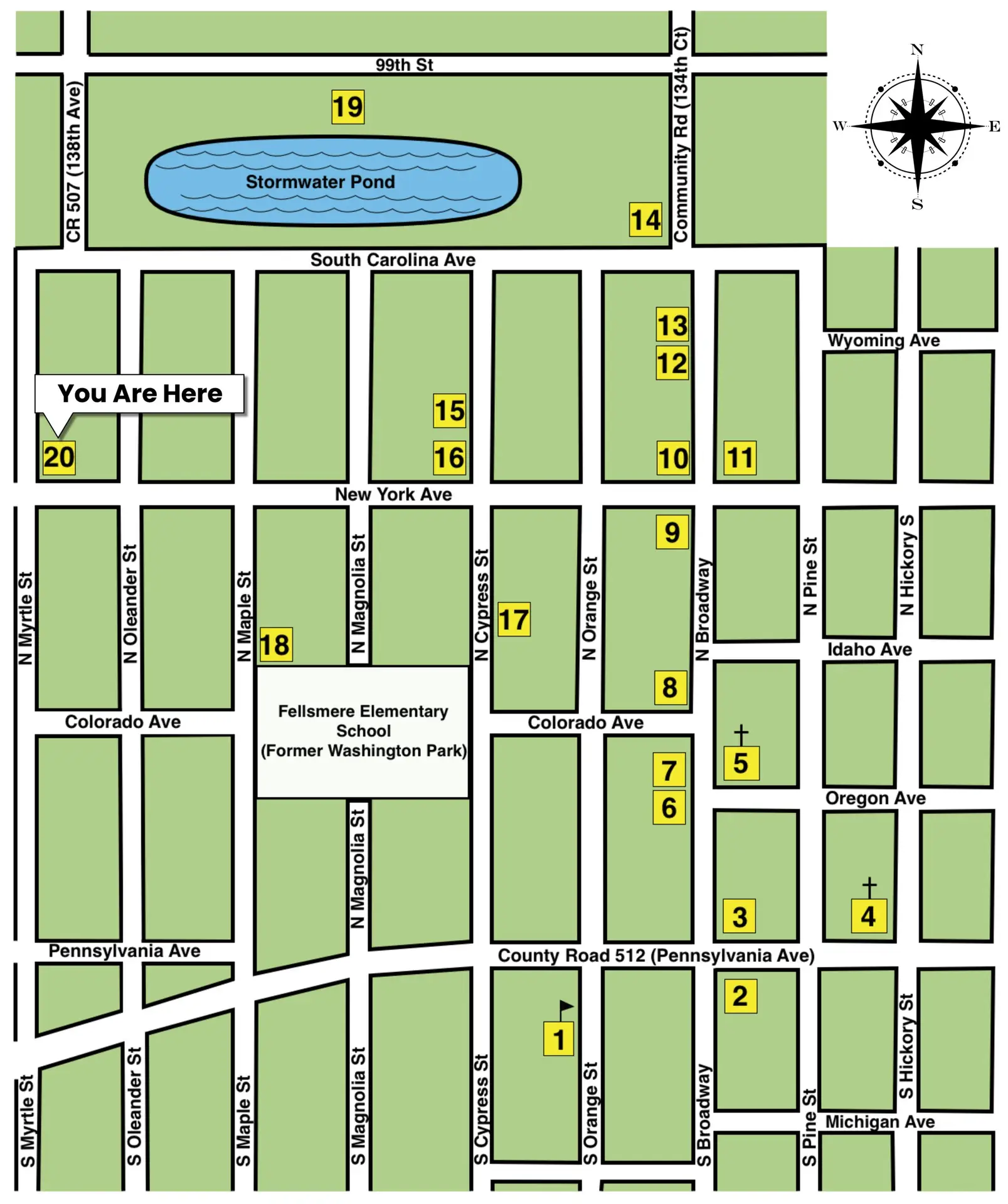
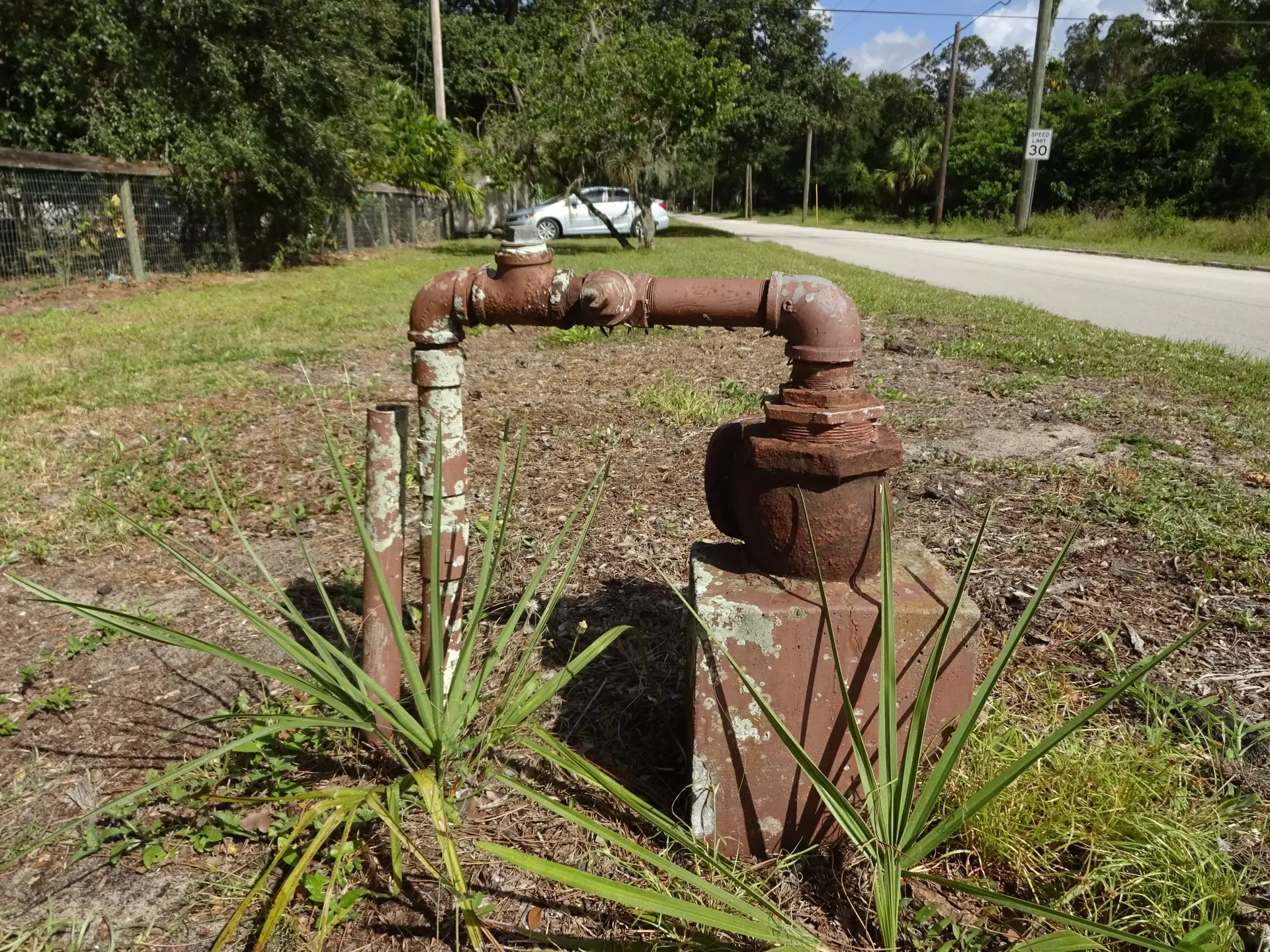
The Fellsmere Farms Company installed and owned Well No. 1 but the actual boring date of the well remains unknown. The original 4” diameter well and gate valve at the wellhead are physically located 83 feet east of the curb on the east side of Myrtle Street, the westernmost platted street in the Town of Fellsmere, and 10.5 feet north of the curb on the north side of New York Avenue in Fellsmere, Florida. Well No. 1 lies entirely within the New York Avenue right-of-way, directly south of Lot 117, Block 136.
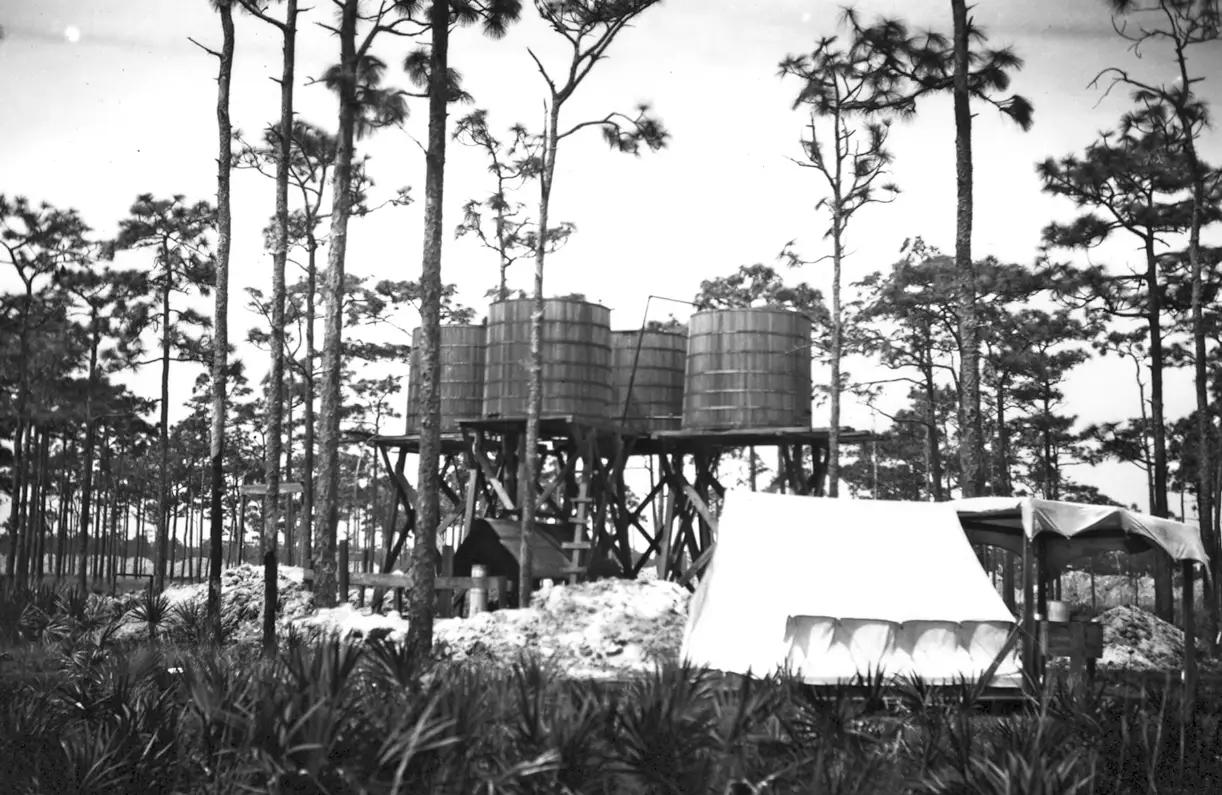
Well No. 1 is typical of the more than 30 artesian wells which were developed in Fellsmere by 1917 to form a water system for the town.6 The artesian wells in Fellsmere typically ranged from 375 feet to 425 feet deep, were 4” in diameter, and yielded about 400 gallons of water per minute at 12 psi pressure equivalent to a height of about 25 feet.7 The Fellsmere Farms Company used gasoline powered well-boring machines that were manufactured by Couch and Jorgenson in Grant, Florida, and transported to Fellsmere by the Fellsmere Railroad on flat cars.8 Initially, a series of seven (7) artesian wells were linked together with pipes (water mains) to provide water to homes and businesses in the north end of the Town of Fellsmere.
On July 11, 1912, it was reported in the Fellsmere Farmer newspaper that “A large water main has been substituted for a small one laid some time ago by the Fellsmere Farms Company and the new pipe now supplies water to residents from the vicinity of the well eastward as far as the Fellsmere Inn.” The Fellsmere Inn was 2,250 feet (approximately ½ mile) east of Well No.1. The water main was located along New York Avenue and ran directly east to the Fellsmere Inn9 at the northeast corner of North Broadway and New York Avenue. Since Well No.1 and the water main were located on New York Avenue, most of the early homes in Fellsmere were built along New York Avenue and in close proximity to New York Avenue along the adjoining side streets.10
In December 1912, the Fellsmere Farms Company announced that it would let a contract for the boring of a 4” diameter artesian well on Lots 27 to 30, Block 44 or the Town of Fellsmere. The southern half of this block faced Tallahassee Park (between Elm and Oak Streets) on Pennsylvania Avenue and was reserved for a “City Hall”.11 Tallahassee Park was a narrow linear strip of land in the middle of Pennsylvania with a large oak tree in the center of it.12 Unfortunately, when State Road (now County Road) 512 was constructed, both Tallahassee Park and the large oak were eliminated. City Hall was never built by the Fellsmere Farms Company or the Town of Fellsmere.
In a letter dated February 15, 1913, from Ernest H. Every, Manager of the Fellsmere Farms Company to James Martell, President of the Fellsmere Farmer’s Fraternity, Ernest Every wrote that: “It may interest you to know that steps are being taken to secure the town of Fellsmere a water system, not only for domestic purposes but also for fire protection. Preliminary work is now being done in the way of investigating the water systems of other towns and a study is being made to determine the size and quality of pipe best suited to our soil and conditions. Although the point has not been definitely decided, it is likely that nothing less than four (4) inch pipe will be used, while the principal mains will be 6” and 8” pipe.
The general plan under consideration includes a centrally located pumping plant, the water to be pumped from artesian wells into a 60,000 gallon tank, the base of which will be elevated about 75 feet above the ground level. This would give a pressure sufficient to throw a large stream of water well over the highest building in town.
It is hardly likely that actual work will commence on the water system for several months, as there are innumerable details to be considered before the plan in its entirety, is passed upon as final, but I do hope to be able to reach conclusions at a reasonably early date on the size and quality of the main pipe to be used in the various streets and depth at which they will be laid, and also as to the size and quality of the small pipes connecting the buildings to the street mains, so that any one putting in pipe connections to the temporary water system may be advised as to the proper kind of pipe to use and thus avoid the necessity of relaying pipe when the pressure system is laid down.” 13
In September 1913, William Dreier, Director of Sales for the Fellsmere Sales Company, and residents W.F. Dole and Roy Kinney were having artesian water piped to their residences from a nearby well on Elm Street.14
In December 1913, the boring of a new well on Broadway had been completed and was ready for new water mains to be laid and connected to the well. A fine head of water was struck at 385 feet and boring was stopped at a depth of 405 feet.15
On January 15, 1914, the Fellsmere Water Company was incorporated for the general purpose of drilling artesian wells, supplying water, laying pipes and mains, installing fire hydrants for fire protection, and any other incidental work to the operation of a water utility. Its initial capital stock was $3,000, and its officers were as follows: George Green, President; George W. Auber, Vice President; E.T. Moore, Secretary; C.M. Conkling, Treasurer with Green, Auber, and Moore as the Board of Directors.16
During 1914, the Fellsmere Water Company published reports of their chemical analysis of the water that was performed by the American Water Testing Company. A comprehensive analysis appeared in the June 20, 1914 edition of the Fellsmere Tribune. The result of the analysis was that “the water, slightly sulfuric in taste, is good and the possibility of infection very remote, as the wells are about 375 to 400 feet deep.” 17
Gail Kinney Griffin, a Fellsmere resident who lived at 99 Maple Street prior to 1934, remembered that her house had city water from artesian wells. She said the water had a sulfur smell to it but it was drinkable. However, she couldn’t use the sulfur water to wash her hair because it made her hair stiff. It also tarnished everything, so the silverware couldn’t be washed in it. Her parents brought soft water in the house every night from a water tank they had outside (most likely a cistern). Gails’ mother heated the soft water in the tea kettle to wash the dishes.18
By July 1914, the Fellsmere Farms Company divested its water utility business. The Fellsmere Water Company bought or leased all of the artesian wells, including Well No. 1, and all of the pipelines installed by the Fellsmere Farms Company. The Fellsmere Water Company later connected all of the Fellsmere Farms Company wells with its own wells to equalize the flow and also laid 3,500 feet of new water mains.19
On June 14, 1915, Doctor E.T. Moore requested permission from the Fellsmere City Council to lay a two inch water pipe along the alley in Block 99 to the north side of New York Avenue, then east across Broadway to his property line on the north side of Broadway. The pipe was to be laid not less than 18 inches below the surface of the ground.20
By 1917, there were approximately 30 artesian wells in the Town of Fellsmere and on Fellsmere Farms Company lands.21
On June 13, 1927, the Fellsmere Water Company and the City of Fellsmere entered into an agreement for one artesian well located at the west end of New York Avenue (Artesian Well No. 1) and one artesian well located in an alley between Blocks 102 and 3 in the Town of Fellsmere.22 On the following day, June 14, 1927, the Fellsmere City Council voted to accept the offer from the Fellsmere Water Company to sell its property to the City and authorized the City Attorney to close the deal.23
At the Fellsmere City Council meeting of July 15, 1927, Mayor McEachron stated that the object of the meeting was to complete negotiations for the purchase of the water system from the Fellsmere Water Company. Councilman Sloan introduced Ordinance 17A which read, “An Ordinance Providing for the Establishment of a Municipal Water Works and Water Supply for the City of Fellsmere, Florida, and Providing for the Purchase and Payment of the same.” The ordinance was adopted by the Council which meant the City of Fellsmere was now the owner and maintainer of a municipal water system.24
On May 12, 1933, the Fellsmere City Council instructed the City Clerk to write to the Reconstruction Finance Corporation for information regarding the procedure necessary to secure funds for improving Fellsmere’s water system.25
On April 13, 1934, Fellsmere City Councilman Bustin discussed building a city water system in Fellsmere with the aid of FERA or the Federal Emergency Relief Administration.26 FERA was a program established by President Franklin D. Roosevelt in 1933, during the Great Depression. This program was replaced in 1935 by the Works Progress Administration (WPA).
On February 15, 1939, Fellsmere City Councilman Ellsworth Weigle made a motion to give authority to G.A. James, Acting City Engineer, to re-open negotiations with the Works Progress Administration for approval of Fellsmere’s water system project.27
On March 20, 1951, J. R. Durrance of J. R. Durrance and Company wrote a letter to the Fellsmere City Council offering financial services for the purpose of improving and extending the City’s waterworks system.28 On May 11, 1951, the City Council held further discussion about extending the water works system, drilling more wells, and improving the water pressure.
By 1990, all of Fellsmere’s water came from individual wells, no longer from the old obsolete artesian well water system. Indian River County Environmental Health Director Mike Galanis wrote a letter to the Farmer’s Home Administration in 1990, stating that Fellsmere’s conditions “pose a serious threat to the health of the residents of the city due to the potential for increased spread of communicable disease.”29 Mayor Joseph Brooks had worked for three previous years to get a water system for the City of Fellsmere, not only for potable water but for fire protection throughout the city as well.30
Consulting engineer Earl Masteller informed the Fellsmere City Council in September 1991 that the Farmer’s Home Administration would pay for half of the $4 million project with a grant and provide the other $2 million in the form of a low interest, long term loan. City officials decided the time was right for Fellsmere to have its own municipal water system and to eliminate all of the private wells within City limits. However, it was not without much controversy before the City could implement it.31
On September 12, 1991, the Fellsmere City Council unanimously approved plans to secure a $2 million loan to help pay for a $4 million water system. It was estimated that 1,500 Fellsmere customers would initially hook up to the system.32 After the City Council’s vote, several people wrote letters against it, and one person threatened to get a petition to hold a referendum on having a water system.33
During the first week in January 1992, Jim Godfrey, who lived just outside the city limits (and was not even a registered voter in the city), had collected enough signatures to force a referendum vote on whether or not the city should construct a municipal water system. He was of the opinion that Fellsmere had no need for a municipal water system and the city did not have the funds to pay for it.
Godfrey was unaware that the State of Florida had mandated installation of a municipal water system in Fellsmere by 1995.34 Despite the mandate, Fellsmere City Councilman candidate Frank Clavelin claimed the project was unnecessary and too expensive.35 The referendum question in regard to whether or not the City of Fellsmere should have its own municipal water system was scheduled by Indian River County Supervisor of Elections Ann Robinson for the city’s March 10, 1992 election. Meanwhile, the Fellsmere Civic League started a counter-petition in support for the water system.36
Tensions ran so high at the February 4, 1992, Fellsmere City Council meeting that project engineer Earl Masteller of Masteller and Moler, Inc. of Vero Beach became frustrated and angry and shouted at the citizens attending the meeting. He closed the meeting with a stinging dose of pessimism by saying that “Any time a public project is put to a vote, it’s doomed to failure because most people don’t know the facts. Very frankly, unless there’s some miracle here, I’m not gonna depend on voters backing the project.” A special call meeting by a sitting councilman was scheduled for February 10, 1992, to discuss the impeachment of Mayor Brooks on charges that wouldn’t be revealed until the meeting.37
On February 18, 1992, a nine page memorandum from the law offices of Roberts and Egan, on behalf of the Fellsmere Property Owners for Controlled Growth, was delivered to Supervisor of Elections Ann Robinson in Vero Beach to halt the printing of the election ballots for the proposed referendum question on the water system.38 Six days later, on February 24, 1992, a special meeting of the Fellsmere City Council was held during which the City Council declined to place the referendum (which would constitute an amendment to the City Charter) on the March 10, 1992 ballot. Three of the five council members voted to decline.39 That vote triggered a class action suit filed by Fellsmere City Councilman George Mraz and two former councilmen against the City and Mayor Brooks demanding that the water system issue be put on the ballot. However, at a hearing on the issue, Circuit Court Judge Kanarek said he could only grant an injunction to stop the city council from its pursuit of the water system if the petitioners proved that irreparable harm would result.40 At this time, Fellsmere had already spent $65,000 on engineering and owed the firm of Masteller and Mole, Inc. approximately $130,000.41
Despite the incendiary atmosphere generated by opposition to a municipal water system, the Fellsmere City Council approved a draft ordinance at its April 9, 1992, meeting mandating use of the system and regulating its operation. Also, rates and installation charges were approved. Minimum monthly charges were $12.50 plus $4 for each 1000 gallons of water used. Installation costs were to be waived for residents who signed up for city water before the system went online. The vote passed by a 3 to 2 majority.42 Unfortunately, that was not the end to the controversy.
On June 27, 1992, Judge Kanarek ruled that Fellsmere should hold a referendum on the municipal water issue.43 Consequently, during its first meeting in July 1992, the Fellsmere City Council voted 3-1, to let the voters decide the issue on September 1, 1992.44 When the results of the vote were finalized, 146 voters voted to have the city proceed with the water system; 113 voters voted against it. Mayor Brooks was ecstatic and said construction could begin within weeks.45 Weeks turned into months, and it wasn’t until after the design was completed, permits were issued, and the project went out for bid that groundbreaking for Fellsmere’s new municipal water system took place on November 8, 1993. It would take about a year to complete the boring of four shallow 10 inch diameter wells, to install the distribution system, to build a small water treatment plant east of Willow Street and just north of 97th Street, and to construct an elevated water storage tank southeast of Fellsmere City Hall at the northwest corner of Broadway and California Avenue.46 The Farmers Home Administration gave Fellsmere a $2 million grant and a low-interest loan for $1.8 million to construct the system. The loan had to be paid back by the city over a 38-year period but all the money in the loan had to be spent before money from the grant could be applied to the project. Project Engineer Earl Masteller remarked that “Without this type of loan, there’s no way that Fellsmere could have this type of viable project.”47
By May 1994, the elevated water storage tank (water tower) had been constructed southeast of Fellsmere City Hall by Caldwell Tanks, Inc. of Louisville, Kentucky. By August 1, 1994, water lines were being installed; sodding of County Road 512 was nearing completion; the water tower had received its finish coat of paint; and the name of “Fellsmere” was painted on the side. Mayor Renee Herrera said that water should be flowing to the homes on the south side of the city by July 1994, and on the north side by November 1994.48
In July, at the recommendation of City Administrator John Little, the Fellsmere City Council decided to lay the city’s water lines along the rear alleys of Broadway to avoid tearing up the sidewalks and having to dig up the street every time a new service line was needed.49
Fellsmere City Administrator John Little announced at the City Council meeting on February 16, 1995, that the water system had been completed and on February 21, 1995, residents’ water would be turned on. The water system, which spanned the entire city, served approximately 850 residents at the time.50 By April 1995, Mayor Bob Baker reported that 407 households had hooked up to the city’s new water system.51 By the end of May 1995, 700 residents had hooked up to the water system.52
A Utility Department, which was overseen by the City’s Finance Director, was created in 1992. In 2019, the City of Fellsmere hired Kevin Burge as its first Utilities Director who concentrates on improving the water quality.53 Today Fellsmerians drink treated potable water and no longer have to drink sulfuric tasting water as they did for many years beginning in 1911.